The
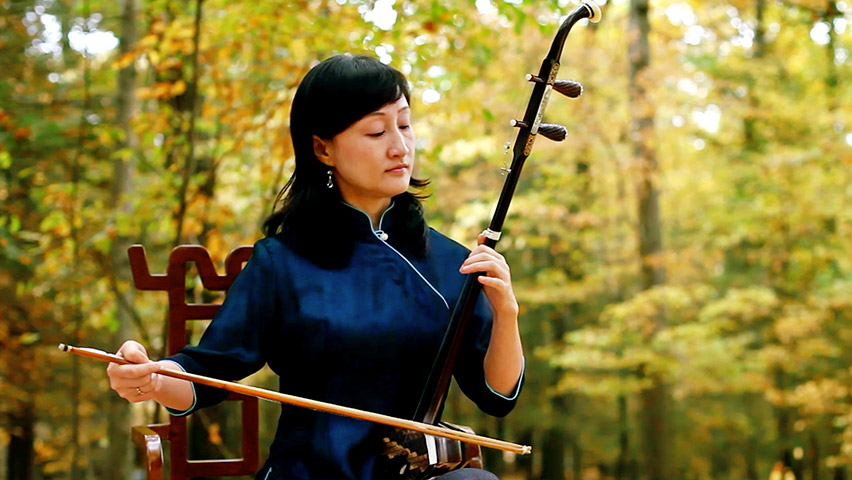
erhu (二胡; èrhú, pronounced "are-who") is a traditional Chinese
instrument which originated over a thousand years ago in Central Asia
among northwestern "barbarian" (i.e. non-Chinese) peoples. It has two
strings, and these couple of facts give the erhu its name: "er/二", "two", and "hu/胡",
"barbarian." An erhu has a small, hexagonal soundbox which rests on the
knee while playing; the front of the soundbox is covered with snakeskin (sometimes synthetic), and the back is left open.
The erhu is a member of the "stick-fiddle" family, and developed out of the ancient huqin (also called "xiqin"). Until the 1900s, the erhu was classified as more of a "folk" instrument in southern China, and used as accompaniment. Developments that came with modernization in all aspects of life in China led to the evolution of the modern erhu, a solo instrument popular in northern China as well as in the south.
 What were these changes?
Major changes involved the "professionalization" of the instrument, so to speak. As a folk instrument, earlier erhus were not always made with the finest materials, or finished to the highest standards. These earlier instruments were also quieter, and made use of silk strings rather than modern steel strings (much like the transition from catgut to steel/synthetics in the violin family).
This created clear differences in a) dynamics and, especially b) timbre.
Dynamics:
The modern erhu is about four times louder, though it still requires amplification for major performances. The soundbox of earlier erhus was smaller, cylindrical, and had a latticework at the back. The modern erhu gained its hexagonal shape in the pursuit of volume, and became larger, lost (most of) the lattice at the back, and gained a taper from front to back, giving the front face greater surface area. Modern erhus also tend to be made of one solid piece of wood (rather than multiple small panels), thicker and higher quality than the older folk style, which enhances its resonance.
Timbre:
The aforementioned changes to the soundbox had some affect on the timbre of the instrument, but probably the most significant impact came from the switch to steel strings from silk. In the words of Colin Huehns:
"The silk string sound is soft and gentle, almost woolly, but also very beguiling; the metal string sound is more robust and smooth. [...] Silk strings tend to give a soft attack and react only gradually to friction with the bow-hair -- a lot of rosin is required: metal strings are much more instantly responsive. In higher registers, silk strings are particularly weak and open strings tend to produce wolf notes* -- not so metal strings. While these are not insurmountable problems by any means, tuning silk strings to lower pitches than metal strings certainly helps" (60).
*Note: a "wolf note" is a note that interacts with the resonant frequency of the body of the instrument, resulting in a fuzzy or stuttering sound.
What do they sound like?
As a folk instrument, there are not really any "old" erhus lying around -- they tended to be thrown away and replaced as needed. The best comparison I could find goes back -- and I mean way back -- one thousand years ago to the original erhu, the huqin.
There are more changes between the huqin and the modern erhu than between the pre-1950 and modern erhu (particularly in the materials the soundbox is made out of -- no snakeskin!), but the comparison still helps give an idea what an older erhu would have sounded like -- especially some of the timbre changes involved with the silk vs. steel strings.
The huqin (also called "xiqin"):
The modern erhu:
Personally, I really like the modern erhu. Its strong, smooth sound (especially how it gets sweet in the upper register!) is very appealing to me, while the more nasal quality of the huqin is a bit less pleasant in some circumstances. It's also nice to have the option of greater volume, which increases the dynamic range available to the performer, and can make a performance more involving (as well as making collaboration between the erhu and other modern instruments easier to balance).
In a preview of my next post, though: My all-time favorite "stick-fiddle" is another descendant of the huqin -- the haegeum. This instrument, the version that developed on the Korean peninsula, retained more of the original characteristics of the huqin (like the silk strings and no snakeskin), but takes the nasal quality of the huqin and adds a depth that makes it very compelling and evocative (it is often compared to a woman wailing).
SOURCES:
Doering, Nicola. “Five Things to Know About… the Erhu – Cultural Keys.” Cultural Keys, www.culturalkeys.cn/2023/02/16/five-things-erhu/. Accessed 29 Feb. 2024.
Erhu | Lan Tung. www.lantungmusic.com/erhu/.
“Erhu – the Sound of China.” China Daily, www.chinadaily.com.cn/citylife/2007-06/25/content_901448.htm.
Huehns, Colin. “The ‘Early Music’ Erhu.” The Galpin Society Journal, vol. 54, 2001, pp. 56–61. JSTOR, https://doi.org/10.2307/842445. Accessed 29 Feb. 2024.
Wikipedia Contributors. “Erhu.” Wikipedia, Wikimedia Foundation, 14 May 2019, en.wikipedia.org/wiki/Erhu.
Hello, Great blog post! I think we have a lot in common because I also choose a Chinese instrument called the Guzheng. I find it so interesting in the second video how she could make so many sounds and have emotion in the music with just 2 strings. I did not know that there is such a thing as a wolf note. Personally, I prefer the silk strings because it is more relaxing and reminds me of the music in historical Chinese dramas or sleeping playlists.
ReplyDeleteI agree that the modern erhu has a stronger and smoother sound as you mentioned. It is very interesting that the instrument was almost disposable. That you would just make or buy a new one when it broke. The shape and open box makes it almost look like a cross between a violin and a banjo. Really cool instrument to do a post on, great job!
ReplyDeleteThe ehru is a really cool sounding instrument, especially since it accomplishes this with only two strings. It's interesting that they modified the physical dimensions to create a louder sound while at the same time increasing it's clarity. Awesome job on the post!
ReplyDelete